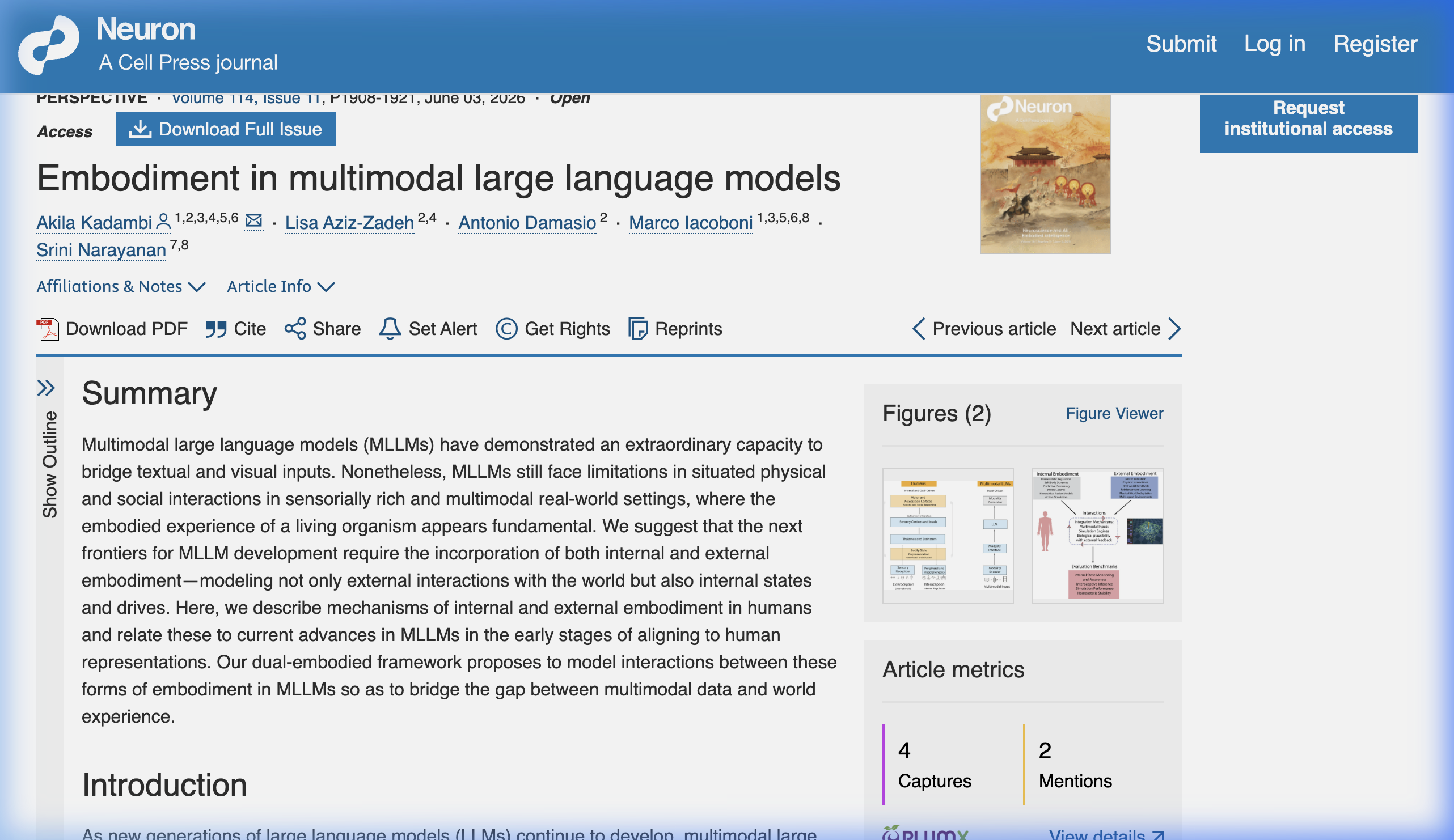
The workshop convenes leading researchers across artificial intelligence, cognitive neuroscience, and robotics to examine how continuous internal state dynamics can be integrated into next-generation foundation models. Program contributors span five core disciplines:
Interoception, visceral feedback, mirror neuron dynamics, and biological homeostasis as foundations for cognition.
Hierarchical action planning, sensorimotor loops, and closed-loop continuous interaction in physical environments.
Extending Transformer and State-Space Model backbones with internal regulatory states and proprioceptive representations.
Intrinsic regulatory constraints, homeostatic coupling, and self-monitoring mechanisms for robust machine alignment.
Formalizing synthetic internal states, continuous monitoring, and simulation-based benchmarks of agentic stability.
Current Multimodal Large Language Models (MLLMs) demonstrate an extraordinary capacity to bridge textual and visual inputs, yet they face significant limitations in situated physical and social interactions.
These models lack bodily experience, understanding the world largely through statistical associations. To achieve greater world comprehension, we posit that models must move beyond token associations toward "felt" cognition supported by internal and external models.
This workshop introduces our Dual-Embodiment Framework proposed recently in Neuron (Kadambi et al., 2026), which integrates two complementary domains: external embodiment (interactions with the external world) and internal embodiment (internal dynamics, proprioception, and homeostasis). We will explore how explicitly operationalizing internal embodiment through our definition of continuous state modeling can be applied toward improvements in AI performance and safety.
Our goal is to convene researchers across frontier disciplines in AI, cognitive science, neuroscience, and robotics, to discuss translating these concepts into implementable architectures and define new internally-aligned benchmarks.
Transforming MLLMs from symbolic processors into agentic systems capable of purposeful interactions and hierarchical action planning across physical/virtual environments and internal regulatory states.
Fostering discussion on integrating internal regulatory objectives to produce more internally-aligned systems. We aim to establish how alignment and safety can emerge from "homeostatic coupling," providing intrinsic incentives for prosocial behavior.
Comparing interoception in biological systems and internal state modeling in artificial systems, and the implications for alternative, artificial forms of consciousness.
Transitioning the AI community toward benchmarks that also measure internal dynamics β self-monitoring, and simulation-based metrics.
Bridging modality encoders, LLMs, and modality interfaces with continuous internal state variables and external environmental interactions.
Modeling behavior in artificial systems using simulated internal states and long-range timescales.
Applying internal state monitoring (e.g., interoceptive inference, homeostatic stability) to world modeling and drawing relationships to AI metacognition and consciousness.
Utilizing homeostatic coupling and internal constraints to intrinsically incentivize prosocial and aligned behavior.
Moving beyond purely external evaluations toward internal self-monitoring and prosocial benchmarks.
Saturday, November 7, 2026 · 10:10 AM β 12:10 PM (Day 3)
The Neuroscience of Internal Embodiment and Dual-Embodiment Frameworks
Setting the stage for the workshop with foundational perspectives on internal embodiment from neuroscience and AI, introducing the continuous state modeling framework.
Continuous Internal Regulators & Proprioceptive Interfaces
Rapid-fire presentations covering proprioceptive feedback, self-monitoring algorithms, and continuous internal regulators.
"AI Safety and AI Performance: Compatible Internal State Dynamics"
A moderated panel exploring the intersection of safety objectives and performance gains through internal state modeling, concluding with collaborative drafting for the Community Roadmap.
Following the workshop, selected speakers, panelists, and interested attendees will collaborate to draft the definitive Vision & Roadmap Paper on Internal Embodiment in AI.
Rather than a traditional call for papers, our workshop focuses on interactive dialogue, synthesis, and collaborative community output. Attendees interested in co-authoring and shaping the future research agenda will join our post-workshop working group across three core pillars:
Standardizing how internal homeostatic loops, proprioceptive feedback, and continuous state regulators integrate into foundation models (Transformers, State-Space Models, and multimodal architectures).
Operationalizing AI safety through 'homeostatic coupling' rather than purely post-hoc external reward tuning (e.g. RLHF), establishing how prosocial behavior and self-monitoring emerge from intrinsic regulatory balance.
Moving beyond static external benchmarks toward dynamic, simulation-based evaluations that measure internal stability, self-monitoring fidelity, interoceptive calibration, and regulatory resilience.
Working Group: Selected speakers and interested attendees can indicate their interest in contributing to the Roadmap Paper during our interactive session or via our registration form.
Publication: The consensus roadmap and key insights will be targeted for publication as a major Perspective / Position Paper in a premier interdisciplinary journal.
Organizer
Workshop Contact
Google DeepMind
UCLA / USC, USA
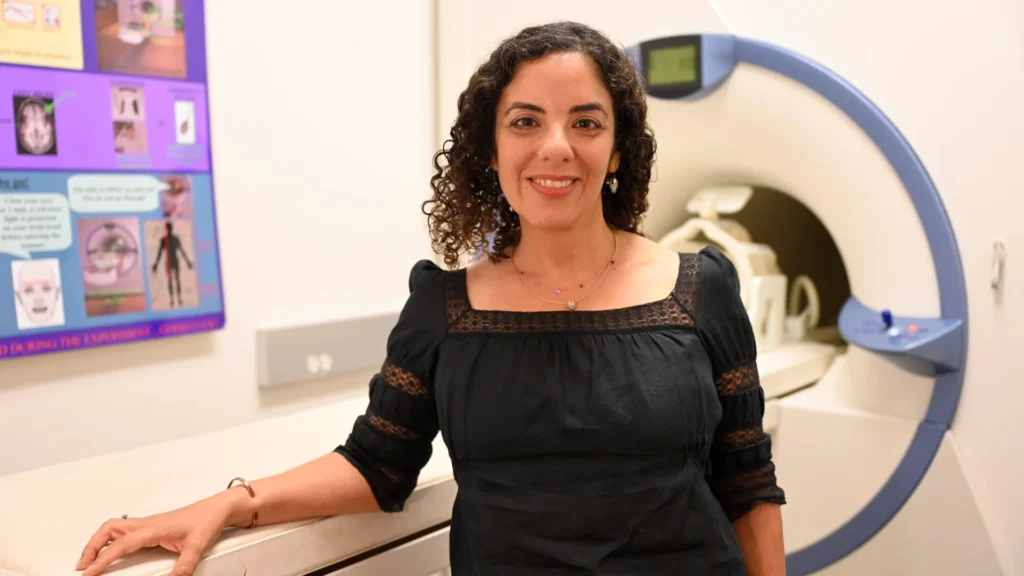
Neuroscientist focusing on the intersection of humanistic and embodied neuroscience, and artificial intelligence architectures.
akadambi@google.comOrganizer
UCLA Brain Research Institute
Semel Institute, USA
Globally recognized expert in the mirror neuron system, action processing, and empathy.
iacoboni@ucla.edu
Organizer
USC Brain and Creativity Institute
USA
Leading expert in the cognitive neuroscience of embodiment, action observation, and how the brain processes social cognition and language.
lazizzad@usc.eduOrganizer
Google DeepMind, Zurich
Switzerland
Distinguished research scientist (Senior Director) who has pioneered work at the intersection of neural theories of language, embodied meaning, and next-generation AI architectures.
srinin@google.comAdditional PC members from the broader embodied AI, cognitive science, and neuroscience communities will be confirmed.
Workshop insights, panel conclusions, and selected contributions will feed into a collaborative Vision & Roadmap Paper on Internal Embodiment in AI.
Formation of a working group dedicated to formalizing rich embodiment metrics across AI, neuroscience, and robotics.
A proposed suite of open-source benchmark datasets related to internal state modeling and homeostatic coupling.
Be part of the conversation shaping the future of embodied AI. Register for our workshop and the AIAS+ 2026 conference.
All participants must also register through the official AIAS+ 2026 registration portal.